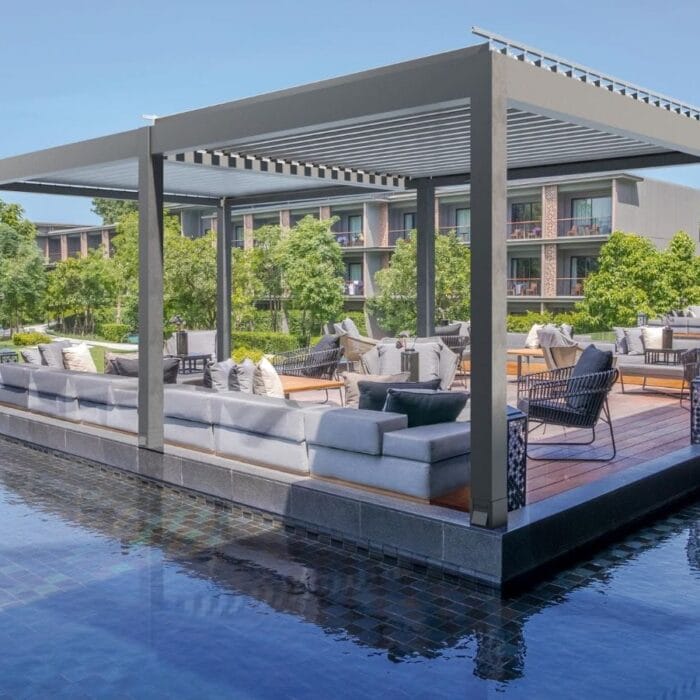
The DMV continues to see strong demand for sophisticated outdoor environments — luxury residences in McLean and Bethesda, rooftop terraces in downtown DC, boutique hospitality projects in Arlington, mixed-use developments across Maryland and Northern Virginia. For architects and designers working in this market, the outdoor space is no longer an afterthought. It’s a primary design element, and clients expect it to perform as well as it looks.
Specifying the right motorized pergola system is a decision that touches structure, aesthetics, climate performance, and regulatory compliance simultaneously. Pergolane is built to support that decision at every stage — from early schematic design through construction administration and final handover.
We work as a true collaborator, not a vendor. Our role is to make your design intent buildable, code-compliant, and deliverable on schedule — while you maintain full creative control.

Architects and designers need partners who engage at the right level of detail, at the right time. Too early and the conversation is premature. Too late and the structural or permitting implications of a specified product create downstream problems.
Pergolane is structured to engage at any stage of your workflow:
During schematic design, we provide product overview documentation, preliminary sizing parameters, and reference imagery to help position the pergola within the overall design concept.
During design development, we supply detailed technical drawings, structural load data, 3D models, and specification language ready for your project manual. For projects requiring BIM coordination, we provide Revit-compatible files.
During construction documents, our engineering team prepares stamped structural drawings and permitting packages tailored to the specific DMV jurisdiction — DC building permits, Maryland county codes, Virginia municipal requirements, HOA submissions, and historic district applications where applicable.
During construction administration, our installation crews coordinate directly with the general contractor, keep to the agreed schedule, and communicate any site conditions that require design team input.
Every Pergolane system is fully engineered to meet DMV-area wind load, snow load, and live load requirements. We prepare stamped structural documentation for permit submission across all DMV jurisdictions and stay current with code cycles in DC, Maryland, and Virginia. For sensitive sites — historic districts, HOA-governed communities, mixed-use zoning — we provide jurisdiction-specific compliance support as a standard part of our process.
We provide regular progress updates, flag issues early, and keep your project team informed without requiring you to chase us. For design professionals who manage multiple projects simultaneously, a reliable communication cadence from a specialty subcontractor is not a small thing.
You can schedule servers for outdoor sections with confidence, reducing last-minute scrambles caused by weather cancellations.
Pergolane’s motorized louvered systems are designed to integrate with contemporary, transitional, and traditional architecture. The slim aluminum profiles, flush detailing, and precision-machined louver operation produce a finished result that reads as architecture — not as a shade product. Clean lines, consistent tolerances, and a range of finishes mean the system adapts to your design, not the other way around.
Motorized pergolas consistently become a signature feature of completed projects. Clients who have lived or worked under a Pergolane system — experiencing the one-touch transition from open sky to full rain protection — tend to cite it as one of the most impactful elements of the project. That outcome reflects well on the design team that specified it.
Adjustable louvers enable natural ventilation strategies and dynamic shading that reduce mechanical cooling loads during DMV summers. For projects pursuing LEED credits or firm sustainability targets, a well-specified motorized pergola can contribute meaningfully to energy performance goals — particularly when it shades south- or west-facing glazing.
What does a Pergolane specification actually look like in a finished project?
On a luxury residential project in McLean, the Signature Louvered Series extends the living room through a full-height glass wall to a covered outdoor dining terrace — same floor level, consistent material palette, fully weatherproofed. The louvers stay open on clear days; a rain sensor closes them automatically before a summer storm arrives.
On a rooftop restaurant in downtown DC, a series of Signature Series pergolas creates a covered outdoor dining room that operates through April showers, August heat, and October cool fronts — adding 40 covers that generate revenue ten months of the year.
On a boutique hotel renovation in Bethesda, Compact Cabana units define individual poolside lounge zones — each with retractable privacy screens, integrated lighting, and infrared heaters — turning the pool deck into a private amenity that guests book specifically.
These are not hypothetical outcomes. They reflect what well-integrated motorized pergola specifications produce in real DMV projects.